
In 2026, the complexity of the smart home has reached a point where a central “brain” is no longer a luxury—it is a functional necessity. While individual smart gadgets are powerful, they often operate in silos. A smart hub breaks down these barriers, acting as a command center that synchronizes every device in your home into a single, high-performance ecosystem.
By consolidating control, these hubs eliminate the need to juggle dozens of different apps. Whether it is managing your security, climate, or lighting, the hub provides a unified interface that makes home management feel intuitive rather than technical. It transforms a collection of “connected things” into a truly intelligent home that responds to your life in real-time.
✨ AI Insight: In 2026, the most advanced hubs feature “Intent Routing,” an AI capability that interprets vague requests like “I’m heading out” to simultaneously lock doors, arm security, and lower the thermostat across different brand ecosystems.
1. Centralized Management: One App to Rule Them All
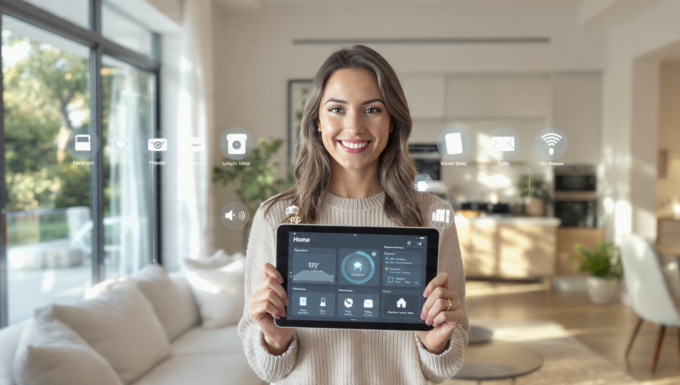
One of the most immediate ways a smart hub improves control is by providing a “single pane of glass” for your entire home. In 2026, you no longer need to switch between a lighting app, a camera app, and a lock app. A hub like the Samsung SmartThings Station or the Apple HomePod mini brings every Matter-certified device into one dashboard.
This centralization significantly reduces “app fatigue” and makes troubleshooting much faster. If a sensor isn’t responding, you can see its status and battery level instantly alongside every other device. This bird’s-eye view allows you to monitor your home’s health at a glance, ensuring that your security and automation systems are always in sync.
2. Local Processing for Instant Response
A major breakthrough in 2026 hubs is the move away from cloud reliance. Modern hubs now prioritize Local Processing, meaning commands are handled directly within your home network. This removes the “round-trip” delay of sending data to a distant server, resulting in near-instant device response.
When you trigger a “Movie Night” routine, the lights dim, the blinds close, and the TV turns on in under a millisecond. Furthermore, this local architecture ensures that your home stays fully functional even if your internet connection fails. Your essential routines, like motion-activated lighting and security alerts, continue to run 24/7 without interruption.
3. Creating Complex, Multi-Device Automations
Individual devices are limited to their own functions, but a smart hub allows for “cross-category” automation. In 2026, your hub can coordinate devices from entirely different manufacturers to work as a team. For example, a leak sensor under your sink can tell the hub to shut off the main water valve and flash your living room lights red to get your attention.
These “If-This-Then-That” scenarios are the true power of a smart hub. You can create sophisticated logic, such as: “If the outdoor camera detects a person after midnight, turn on the porch lights and announce ‘Visitor Detected’ on all smart speakers.” This level of coordination provides a layer of proactive protection and convenience that standalone gadgets simply cannot achieve.
4. Bridging the Gap Between Old and New Tech
Not every device in a 2026 home is a brand-new Matter-certified model. Many homeowners still rely on reliable Zigbee or Z-Wave devices from previous years. A versatile smart hub like the Aqara Hub M3 acts as a “universal bridge,” translating these older protocols into the modern Matter standard.
This “Backward Compatibility” ensures that your existing investments are not wasted. The hub allows your older sensors and switches to participate in the latest AI-driven routines alongside the newest hardware. It simplifies the transition to a modern smart home, allowing you to upgrade your tech at your own pace without losing control over your current setup.