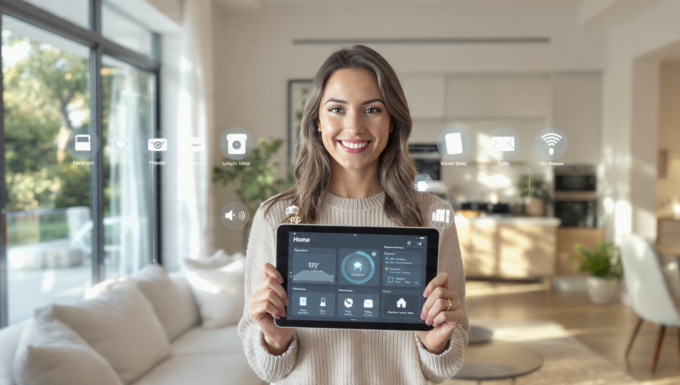


In 2026, the promise of a truly “unified” smart home has finally been realized through Matter. For years, the smart home industry was fragmented, with devices from different brands refusing to work together. Matter has changed this by providing a universal language that allows every gadget in your house—regardless of who made it—to speak to each other seamlessly.
This shift isn’t just about technical compatibility; it’s about a fundamental change in the user experience. By removing the “walled gardens” of the past, Matter has made the smart home more reliable, secure, and significantly easier to manage for the average family.
✨ AI Insight: By 2026, Matter 1.5 has expanded to include high-bandwidth devices like 4K security cameras and major appliances, ensuring that your entire household is now part of a single, coordinated ecosystem.
1. The End of “App Fatigue”
The most immediate change Matter brings to the 2026 home is the end of “App Fatigue.” In the past, adding a new smart light or lock often meant downloading yet another proprietary app. With Matter, any certified device can be set up and controlled using the app you already prefer—whether that’s Apple Home, Google Home, or Amazon Alexa.

This is made possible by the Multi-Admin feature. It allows a single device to be connected to multiple platforms simultaneously. If you prefer using an iPhone but your partner uses an Android, you can both control the same smart lights from your respective native apps without any conflict.
2. Local Control: Speed and Reliability
Before Matter, many smart devices relied on the “cloud” to process commands. If your internet went out, your smart home stopped working. Matter has changed this by prioritizing Local Control. Commands are sent directly from your hub or phone to the device over your home network.
This results in near-instant response times. When you walk into a room, the motion sensor triggers the light in milliseconds because the data doesn’t have to travel to a distant server and back. It also means your essential routines—like security and climate control—will keep working even if your internet service provider has an outage.
3. The Power of Thread Mesh Networking
Matter doesn’t just change the software; it leverages a powerful new hardware standard called Thread. In 2026, most low-power devices like door sensors and smart locks use Matter-over-Thread to create a self-healing mesh network.
Unlike Wi-Fi, which can become congested with too many devices, Thread gets stronger as you add more gadgets. Every “always-on” device, like a smart plug, acts as a repeater, extending the range and reliability of your network to the far corners of your home.

4. Simplified Setup with QR Codes
The technical hurdle of “pairing” devices has been replaced by a simple QR code scan. In 2026, setting up a new Matter-certified device takes less than thirty seconds. You simply scan the code with your phone, and the Matter controller handles the secure handshake and integration into your network.
This “Plug-and-Play” simplicity has democratized the smart home. You no longer need to be a tech expert to build a sophisticated system. By making the technology invisible, Matter allows homeowners to focus on the benefits of automation rather than the frustration of troubleshooting.