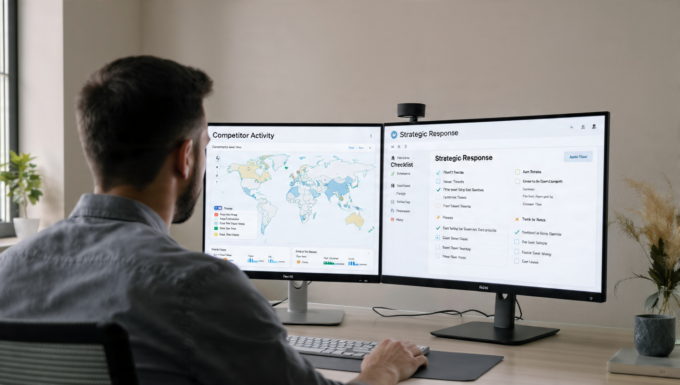

The image of a small business owner staying up late to manually reconcile spreadsheets or draft promotional emails is rapidly becoming a thing of the past. For many entrepreneurs, the goal is no longer just to “keep up” with technology, but to use it as a silent partner that handles the logistical weight of the company.
AI tools for small businesses have shifted from experimental add-ons to essential operational infrastructure. By automating the mechanical aspects of marketing and business management, these systems allow lean teams to function with the same level of sophistication as much larger competitors.
✨ AI Insight: Small business AI adoption has transitioned from simple content generation to integrated “orchestration,” where tools now communicate with each other to manage end-to-end workflows. This allows founders to shift their focus from daily maintenance to high-level strategy and relationship-building.
The Democratization of Professional Marketing
Marketing was once the most significant hurdle for small businesses, often requiring a choice between high agency fees or time-consuming DIY efforts. Modern AI marketing platforms have leveled this field by providing tools that generate on-brand creative assets and optimized copy in minutes.

These systems do not just produce generic text; they learn a brand’s specific voice and style to ensure consistency across social media, email, and websites. By providing a “running start” on every campaign, they allow business owners to act as editors rather than creators.
This shift ensures that even a solo founder can maintain a high-frequency, professional presence across multiple digital channels. The technology handles the initial heavy lifting, ensuring that the brand remains visible and credible without the need for a dedicated marketing department.
Intelligent Systems for Customer Engagement
Customer expectations for instant service have made 24/7 responsiveness a requirement for modern success. Small businesses are increasingly adopting AI-powered chat and support systems that can answer FAQs, qualify leads, and even process simple orders.
Unlike the rigid chatbots of the past, these modern assistants utilize natural language processing to understand the nuance of a customer’s inquiry. They provide immediate help while preserving the full context of the conversation for a human agent to step in when necessary.
By handling the volume of routine inquiries, these tools protect the business owner’s time for complex or high-value customer interactions. The result is a more responsive service experience that builds trust and prevents potential sales from falling through the cracks.
Streamlining Business Operations and Data
Behind the scenes, the “busywork” of managing a business—invoicing, inventory tracking, and data entry—is being absorbed by intelligent software. AI agents now act as the connective tissue between different business apps, ensuring that data flows seamlessly without manual updates.
These systems can identify trends in sales data or predict inventory needs before a shortage occurs, allowing for much more precise operational planning. By removing the guesswork from these decisions, small businesses can operate with significantly lower overhead and waste.
This level of operational clarity was previously only available to large enterprises with massive data teams. Today, a simple integration allows a small shop to have the same predictive insights, ensuring they are always prepared for market shifts or seasonal demands.
Why It Matters
For a small business, time is the most valuable and limited resource available. Adopting AI is not about replacing the human element of the brand, but about freeing that human element to focus on the things that truly drive growth: innovation and connection.
When the mechanical tasks of marketing and management are handled by reliable systems, the risk of founder burnout decreases. This allows the business to remain resilient and scalable, “punching above its weight” in an increasingly competitive and fast-moving digital economy.
Ultimately, the goal of these tools is to make the technology disappear into the background of a well-run company. The most successful small businesses are those where the technology supports the mission so effectively that the owner can spend their day doing the work they actually love.