


In today’s landscape of health technology, the fitness ring has emerged as a powerhouse of miniaturized engineering. Unlike bulkier wrist-worn devices, these rings leverage the unique anatomy of the finger to capture high-fidelity biological data.
By sitting flush against the digital arteries, a fitness ring gains a much cleaner signal for monitoring your internal state. This strategic placement allows for 24/7 data collection that is both less intrusive and more accurate for specific resting vitals.
✨ AI Insight: Modern rings use “Multi-Signal Fusion” to cross-reference motion and heart rate data, accurately distinguishing between high-intensity exercise and everyday gestures.
The Core Technology: Optical PPG Sensors
At the heart of every fitness ring is Photoplethysmography (PPG), a sophisticated optical technology used to measure changes in blood volume. Small LEDs on the inner band shine light into the skin, which is then reflected back to a photodetector.
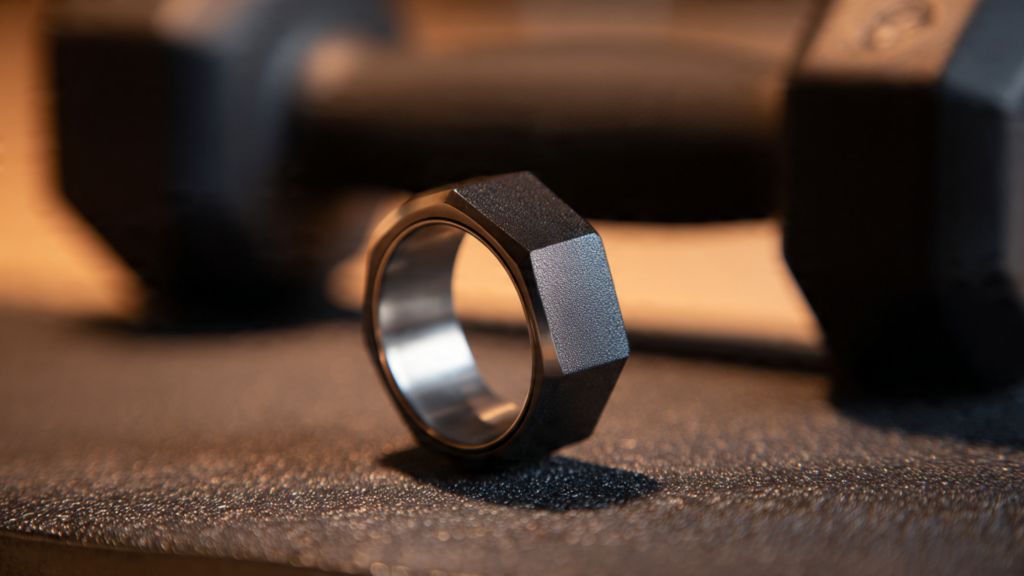
When your heart beats, blood surges into the capillaries of your finger, absorbing more light; between beats, the volume drops and more light is reflected. The ring’s processor analyzes these rapid light-intensity shifts to calculate your heart rate and oxygen saturation (SpO₂).
This finger-based approach is often superior to wrist-based sensing because the finger has a higher vascular density and less bone interference. It results in medical-grade precision for heart rate variability (HRV), which is the primary metric used to assess your body’s stress and recovery levels.
Motion Sensing with 3-Axis Accelerometers
To track physical movement, fitness rings utilize ultra-compact 3-axis accelerometers and gyroscopes. These sensors monitor acceleration and orientation across three different planes, capturing every motion from a vigorous run to a subtle hand gesture.
Sophisticated algorithms process this raw motion data to count steps, estimate distance traveled, and calculate total calories burned. By analyzing the “rhythm” and “amplitude” of your movements, the ring can automatically distinguish between walking, running, and household chores.
Advanced Sleep and Recovery Logic
One of the most valuable ways a fitness ring tracks activity is through its analysis of your “resting” hours. By combining motion data with heart rate and skin temperature, the ring can pinpoint exactly when you enter different sleep stages.
It tracks the micro-movements of your hand during the night to determine if you are in light, deep, or REM sleep. This high-resolution monitoring provides a “Sleep Score” that tells you how effectively your body recovered from the previous day’s physical and mental stress.
This data-driven approach turns sleep into a measurable “activity” that directly influences your performance for the next day. It provides the clarity needed to adjust your routine, ensuring that your training intensity is always aligned with your body’s actual recovery state.
Integrated Skin Temperature Monitoring
Modern fitness rings are equipped with high-precision thermistors that track your skin temperature multiple times per minute. This continuous monitoring identifies subtle “thermal trends” that can signal the onset of an illness or a shift in your metabolic state.
Because the ring maintains a constant, snug connection with your skin, it can detect variations as small as 0.1 degrees Celsius. This data is particularly useful for tracking menstrual cycles or identifying if your body is struggling to recover from an intense workout.
Real-Time Stress and Focus Tracking
Beyond physical movement, the fitness ring monitors your nervous system by analyzing the time intervals between each heartbeat. This allows the device to provide a real-time “Stress Score,” helping you identify which parts of your day are taxing your mental energy.
When your HRV drops, indicating higher stress, the ring’s companion app may suggest a brief mindfulness session or a break from your current task. This proactive support helps you maintain a balanced state of focus, improving both your productivity and your long-term wellness.
By tracking these “invisible” activities, the ring provides a holistic view of your health that goes far beyond simple step counting. It ensures that you are managing your mental and physical resources with surgical precision, leading to a more consistent and high-performing lifestyle.
Energy Expenditure and Metabolic Insights
To provide a complete picture of your daily activity, fitness rings calculate your Total Energy Expenditure (TEE). This includes your “Active Burn” from movement and your “Basal Metabolic Rate,” which is the energy your body uses while at rest.
By monitoring your heart rate throughout the day, the ring can determine the intensity of your efforts more accurately than a simple step counter. This ensures that a high-intensity
session—like weightlifting or rowing—is correctly credited toward your daily caloric goals.
The Future of Invisible Health Tracking
The ultimate goal of fitness ring technology is to make health tracking “invisible,” allowing the user to gather data without any manual effort. As sensors become even smaller and more efficient, the accuracy of these devices will continue to rival professional clinical equipment.
In the near future, rings may even incorporate non-invasive sensors for blood glucose and hydration monitoring, providing a total biological dashboard on your finger. This constant stream of data is what makes the fitness ring the definitive tool for personal longevity.
By turning your body’s subtle signals into actionable advice, the fitness ring helps you master your daily routine. It empowers you to live more intentionally, ensuring that every movement and every moment of rest is working toward a healthier, more capable version of yourself.